Provocation 2
We can be agents of validity or victims of cheating.
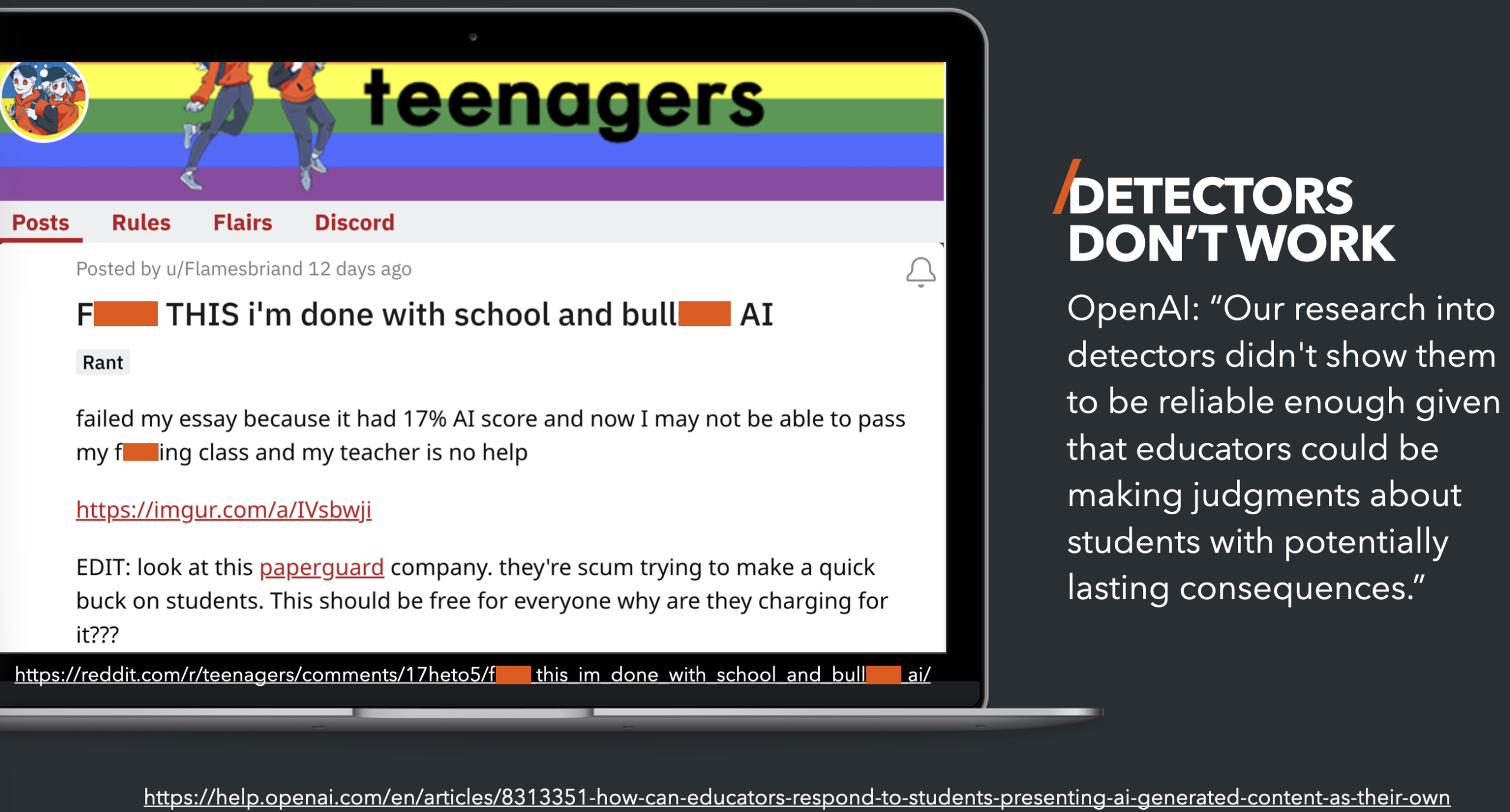
We cannot control cheating and focusing on it will lead to an adversarial relationship with students; where we have agency is in how we engage students with more meaningful tasks that lead to an accurate understanding of student learning.
I am not someone who deals well with change. My coping mechanism is to try and get out in front and direct the change to whatever extent I can. In other words, when I have some level of agency, I am better able to deal with unavoidable change. Agency is the key to maintaining a positive and productive response in the face of incredible technological changes, noted the great self-efficacy theorist Albert Bandura in a 2002 article.
In our conversations at the convening, the panel agreed from the beginning that this statement needed to re-focus the attention from accusations of student cheating to the teachers’ responsibility for establishing assessment validity. For a long time, the provocation was simply stated as the title of Philip Dawson’s 2024 article, “Validity Matters More Than Cheating”[2]. This article nails it by going “beyond drawing a connection between ‘validity’ and ‘cheating’ to propose that validity is a more useful conceptualisation than cheating for all but the moralistic elements”(Dawson, 2024).
In my many presentations on AI in education, I have tried to reassure teachers that they can still have agency over learning. I don’t pull punches. Cheaters gonna cheat, I point out, reminding them that cheating was a thing before AI and will continue to be a thing. What they can do about it is have agency over establishing assessment validity. Again, nothing new. I remind them that math teachers had to change how they assigned and assessed math work after the release of PhotoMath in 2014. This is an app that uses the phone camera to capture and solve math problems. Even earlier, language teachers had to modify their instructional practices with the wide release of Google Translate in 2010.
In a very prescient article released in early 2022, Claire Knowles shared the ADAPT approach to accommodating for Google Translate in Spanish instruction[4]. ADAPT stands for “amending assignments, discussing Google Translate, assessing with Google Translate in mind, practicing integrity, and training students to use Google Translate” and would be a great approach for addressing GenAI as well (Knowles, 2022). The key, once again, is that the approach focuses on teacher agency rather than student cheating.
Agency is the difference. If teachers are able to come to terms with the situation and engage in effective change, they will feel more confident and in control. The other option is to fall into a spiral of blaming students for cheating, blaming the technology for ruining things, and despairing over a bleak future for education…and yes, I bring receipts. This type of adversarial relationship isn’t healthy for either party.
The solution we propose is to focus on teacher agency around establishing validity. But what is valid in assessment? Again, wicked problem and underlying issues; we do a horrible job of preparing teachers for developing assessments and understanding the nuances therein. Dawson’s article provides a great starting point for understanding validity. In brief, “a students’ assessment submission is valid if it represents their actual capability”(Dawson, 2024). It gets more complicated, of course, but Dawson’s argument is that if we make it more difficult then it becomes harder for teachers to actually implement.
This is an area that needs more work, especially in K-12 education. Teachers need a more approachable understanding of assessment and validity.